
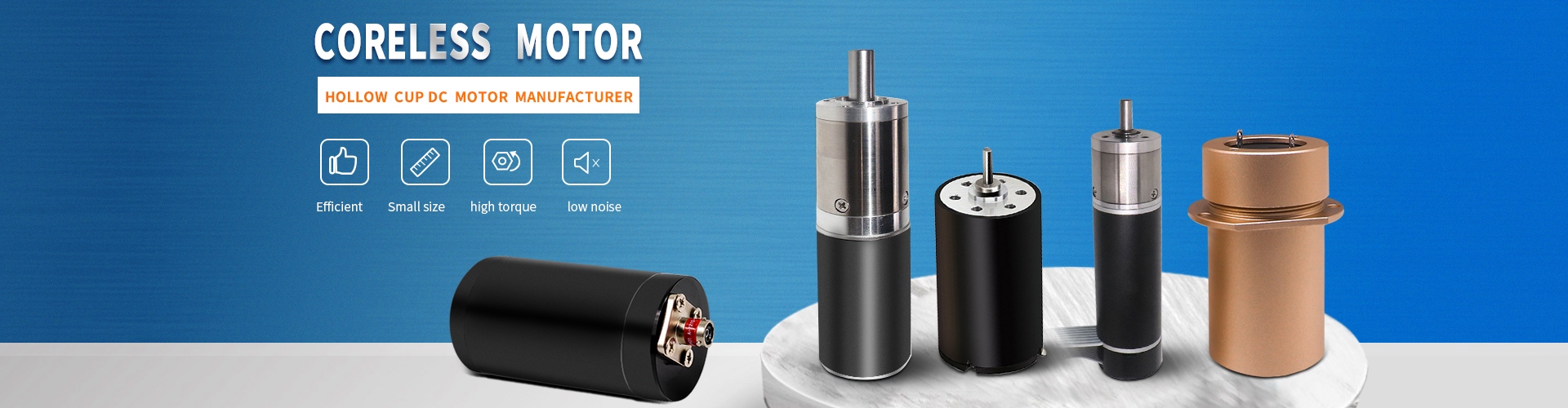
The humanoid robot industry is advancing rapidly, with companies worldwide racing to develop platforms capable of performing human-like tasks in manufacturing, logistics, healthcare, and service environments. Among the many technical challenges facing humanoid robot designers, achieving natural, dexterous motion remains one of the most demanding. Hollow cup coreless motors are emerging as a critical enabling technology for humanoid robot hands, wrists, and articulated joints, delivering the combination of high torque density, rapid response, and smooth, precise motion that these advanced platforms require.

Humanoid robot hands demand actuators that can replicate the remarkable dexterity of the human hand, which contains over 20 degrees of freedom and can perform tasks ranging from delicate object manipulation to powerful gripping. Coreless motors, with their ironless rotor construction and low inertia, deliver the fast, precise motion required for finger articulation and force control. The zero-cogging characteristic of these motors ensures smooth motion at any speed, critical for natural-looking movement and safe human-robot interaction. Robot designers report that coreless motor-driven fingers achieve response times and force control accuracy approaching those of biological systems, enabling humanoid robots to handle fragile objects, operate tools, and perform assembly tasks with unprecedented dexterity.

The power density of coreless motors is particularly valuable in humanoid robot applications, where every gram of weight saved contributes directly to improved dynamic performance and extended battery life. By reducing the weight of hand and wrist actuators, designers can increase payload capacity or improve agility. The compact form factor of coreless motors also enables more human-like hand proportions, a key consideration for robots designed to operate in human environments and use human tools. Leading humanoid robot developers are increasingly specifying coreless motors for their latest generation platforms, citing the technology’s contribution to improved dexterity and more natural motion.

Beyond humanoid robots, dexterous robotic hands powered by coreless motors are finding applications in teleoperation systems, where human operators control robotic hands to perform tasks in hazardous or remote environments. The precise force feedback and smooth motion enabled by coreless motors make these systems feel natural to operate, improving task performance and reducing operator fatigue. As the robotics industry continues to push toward more capable, natural, and efficient platforms, the role of coreless motor technology in enabling these advancements is expected to expand significantly.

Post time: Oct-23-2026