
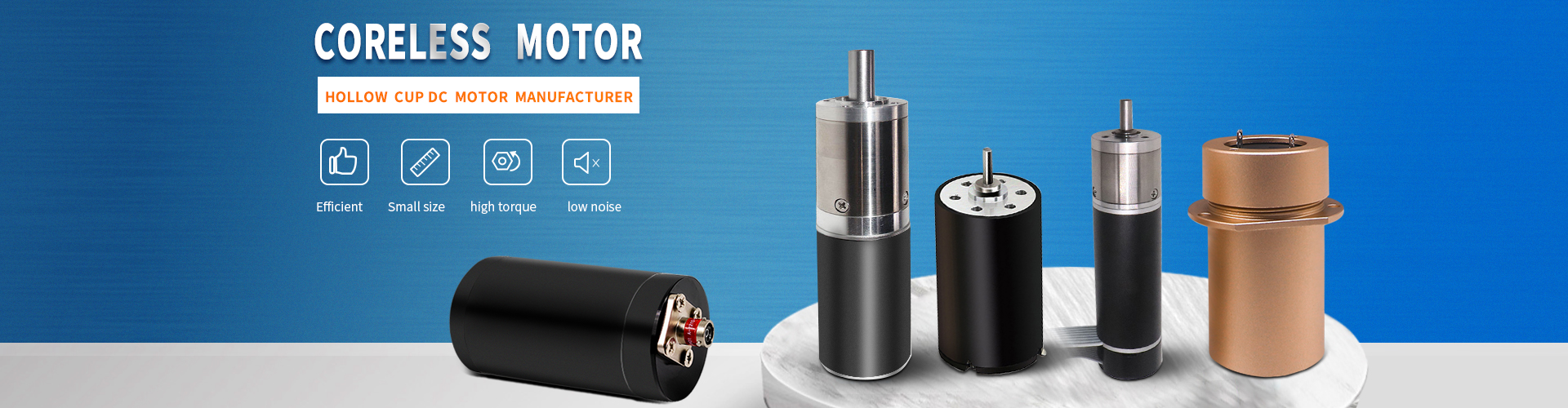

With the explosive growth of the humanoid robot industry, the ability to make a robot's "hands" as flexible and precise as a human's has become one of the industry's most significant challenges. In this race for dexterity, Coreless Motors have emerged as the absolute mainstay for dexterous hand joint actuation, thanks to their outstanding application skills in miniaturization, high torque density, and ultra-fast response.
The Space Constraint: Why Traditional Motors Fail
A humanoid robot's dexterous hand is a marvel of engineering. It must integrate dozens of drive units—often 10 to 20 motors per hand—within a volume roughly the size of a human palm. Traditional iron-core motors, with their bulky laminated steel structures, simply cannot fit into such confined spaces while delivering sufficient torque. Coreless Motors solve this problem through their unique self-supporting cup-shaped winding. By eliminating the iron core entirely, they achieve an ultra-high power density that shines in this application—delivering enough torque to grasp heavy objects within a volume of just a few millimeters in diameter. This allows the robot's fingers to not only perform simple grips but also execute fine operations like picking up a needle, unscrewing a bottle cap, or even solving a Rubik's cube.
The Response Challenge: Millisecond-Level Compliance Control
More importantly, the low inertia of coreless motors gives the robot extremely fast dynamic response capabilities. When a humanoid robot walks in a complex environment or grasps fragile objects like a paper cup or an egg, the motor must instantly sense resistance changes and adjust its output torque in real-time. This is known as "compliant control"—a skill that traditional motors struggle to achieve due to their higher rotor inertia. With Coreless Motors, the robot's fingers can "feel" the object and modulate their grip force within milliseconds, achieving a level of gentleness and precision that rivals human touch. This application skill not only makes the robot's movements more natural and fluid but also greatly improves safety during human-robot collaboration.
The Endurance Challenge: Efficiency and Thermal Management
In a humanoid robot, every watt of power matters. Coreless Motors offer significantly higher efficiency than traditional motors because they eliminate eddy current and hysteresis losses caused by the iron core. This means less heat generation and longer battery life for the robot. For a humanoid robot expected to work an 8-hour shift in a warehouse or assist elderly patients at home, this thermal and efficiency advantage is not just a luxury—it is a mission-critical requirement.
The Future: Enabling True Human-Robot Collaboration
As the humanoid robot industry moves from laboratory prototypes to mass production, the demand for high-performance Coreless Motors will only intensify. Industry analysts predict that the global market for coreless motors in robotics will grow at a compound annual growth rate (CAGR) of over 15% in the next five years. This application skill—combining miniaturization, precision, and efficiency—is laying a solid physical foundation for humanoid robots to truly enter homes, hospitals, and service scenarios. The age of dexterous, human-like robots is no longer a distant dream; it is being driven, millimeter by millimeter, by the quiet revolution of Coreless Motor technology.
Post time: Oct-09-2026