
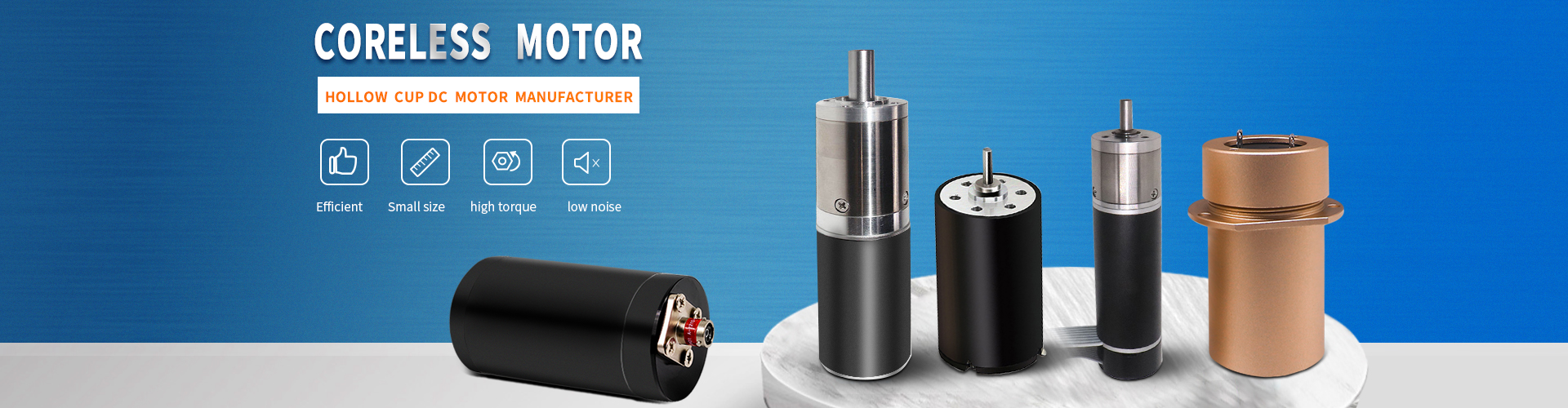
Portable electronics designers are increasingly turning to hollow cup (coreless) motor technology to solve the perennial engineering challenge of balancing compact form factors with operational endurance. In traditional iron-core motors, the rotating armature contributes substantial eddy current and hysteresis losses even under no-load conditions, draining precious battery capacity that could otherwise be used to extend device runtime. Coreless motors eliminate the iron mass entirely, reducing rotor inertia by up to 80% while boosting peak efficiencies beyond 85%—a substantial gain over the 65–75% efficiency range typical of miniature iron-core designs. This efficiency advantage translates directly into longer battery life across a wide range of portable and wearable devices.
Real-world integration tests in sub-250g camera drones reveal that swapping standard coreless motors for next-generation variants with optimized air-gap windings yields a 32% extension in hover time per battery cycle—a difference that can transform a drone’s operational utility in commercial inspection and search-and-rescue applications. For wearable exoskeleton joints and gesture-recognition smart rings, the reduction in operating temperature—often 12–15°C lower than equivalent iron-core motors—not only preserves lithium-polymer battery health and extends battery cycle life but also enables fully sealed, dust-proof enclosures that were previously impossible due to heat accumulation concerns.
Manufacturers are now introducing coreless motors with integrated Hall-effect sensors in diameters as small as 6 mm, maintaining output torque densities above 12 mNm while weighing under 2.5 grams. These micro drives are enabling entirely new product categories, including smart drug injectors that perform precise rotary-pumping actions for automated insulin delivery, foldable smartphone camera modules that deploy in under 200 milliseconds, and haptic feedback actuators that provide rich tactile sensations in ultra-thin smartwatches. The combination of miniature size, high efficiency, and smooth torque output is also driving adoption in AR/VR headset autofocus systems, where precise and rapid lens positioning is essential for user comfort and image quality.
Thermal management has historically been a key consideration for continuous-duty coreless motor applications, and recent innovations in thermally conductive epoxy potting materials have effectively addressed this concern. New generation hollow cup motors now incorporate direct winding-to-housing heat extraction paths using ceramic-filled compounds with thermal conductivity exceeding 2.5 W/m·K, allowing continuous torque output up to 70% of stall rating without thermal derating. This advancement opens new opportunities in drone propulsion and robotic actuation, where sustained operation and aggressive maneuver profiles previously pushed coreless motors beyond their thermal limits. Additionally, the development of advanced rotor balancing techniques has reduced vibration levels to below 0.5 mm/s, making these motors suitable for optical and imaging applications where even minimal jitter can compromise performance.
With consumer demand for all-day wearables, palm-sized aerial platforms, and increasingly sophisticated portable medical devices accelerating, industry analysts project the hollow cup motor market to grow at a compound annual growth rate of 9.8% through 2030, driven largely by efficiency, miniaturization, and reliability requirements. The Asia-Pacific region, particularly China, South Korea, and Japan, continues to dominate manufacturing capacity and cost-competitive production, while North American and European medical device and consumer electronics companies lead in high-value application development and system integration. The emergence of new applications in automotive interior actuation, smart home devices, and industrial sensors is further expanding the addressable market for this versatile motor technology.
Post time: Jul-03-2026